We run a waterfall across 7 data providers. Here's what each is actually for.
2026-07-05· 6 min read
Waterfall enrichment means trying data providers in sequence: if provider A can't find a verified email or mobile for a record, provider B gets a shot, then C — and you only keep (and pay for) what actually hits. No single provider covers everyone. A waterfall turns seven partial databases into one good one.
We don't write about this from the outside. Every reveal on Leaderra runs through a waterfall we built, tuned and re-tuned on our own money. This is what we learned about each provider people keep asking us to compare — and why the ordering logic matters more than any name on the list.
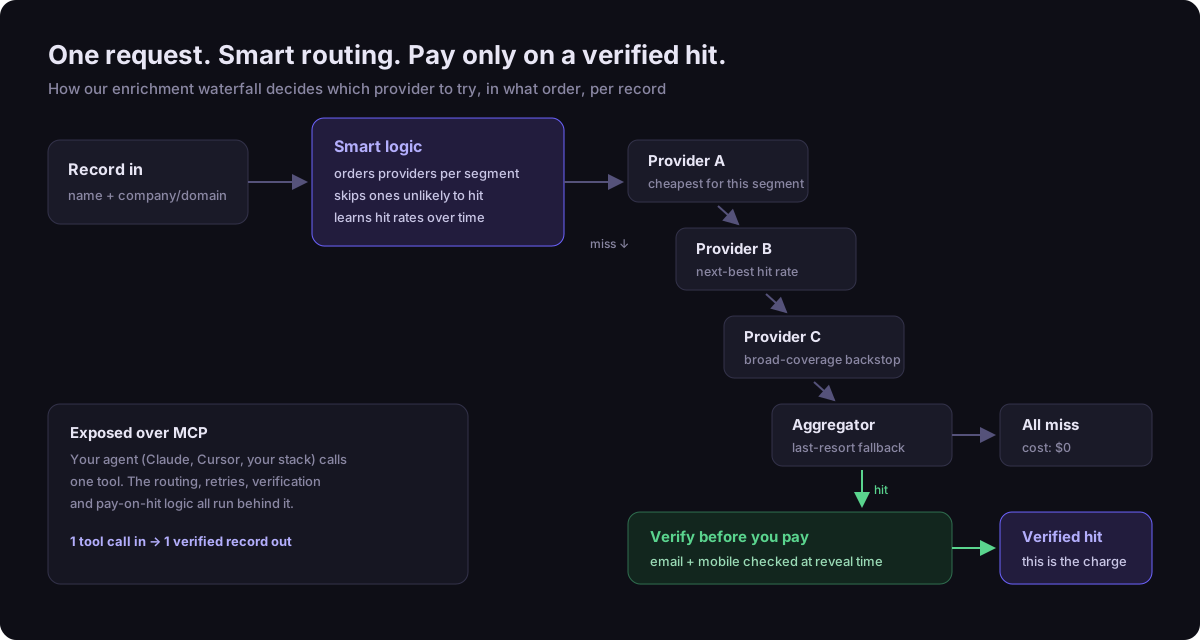
How a smart enrichment waterfall routes one record: segment-aware provider order, verification before payment, exposed to AI agents as a single MCP tool
What each provider is actually for
Names first, honesty included. "Do we run it" means in production, on paying traffic, today.
Provider
What it really is
Where it wins
Do we run it
LeadMagic
Email + mobile finder with cheap firmographics
Firmographic lookups at $0.01/record — the cheapest first hop we found
Yes
Prospeo
Email finder + verifier, strong from a LinkedIn URL
LinkedIn-based lookups; solid hit rates on EU records
Yes
Apollo
Huge static B2B database with an API
On-file emails and org data at low cost; breadth
Yes
Coresignal
Raw public-web people/company data, sold as datasets and API
A waterfall-as-a-service — ~15 providers behind one API
When your own chain misses; phone coverage
Yes — as last-resort fallback
PDL (People Data Labs)
Deep person/company enrichment API
Record depth and quality — genuinely excellent
Tested, shelved (cost — below)
Hunter
Domain-based email finder + verifier, the classic
Simple domain→email patterns, small teams, generous free tier
No — never needed it in our chain
Clay
Not a provider — an orchestration canvas over 100+ sources
Building your own custom waterfall without writing code
We're a source inside it, not a user of it
Three of these deserve the longer version.
PDL taught us the difference between quality and value. We tested it on real records in June. The data was the best in the table — depth, accuracy, coverage. It's also ~28¢ a credit, which worked out to roughly $1.50 per completed record the way enrichment consumes credits. Our production chain lands the same job at about $0.08. So PDL sits shelved, waiting for a "deep enrich" premium tier where $1.50 is justified. Quality you can't afford at volume isn't quality — it's a demo.
FullEnrich is the honest benchmark for build-vs-buy. It is a waterfall — fifteen-odd providers behind one API call. If you don't want to build routing, it's the shortcut. We keep it as our final fallback instead of our whole strategy for one reason: a rented waterfall runs the same static order for everyone. Ours re-orders per record, and that's where the margin lives.
Clay isn't on the same axis as the rest. It orchestrates providers; it doesn't have data of its own. Comparing "Clay vs Apollo" is comparing a kitchen to an ingredient. If you have a GTM engineer who wants full control, Clay is the canvas — and our waterfall endpoint is a step you can drop into it, primary or fallback.
Why the same providers produce different results for different teams
Here's the part the provider-comparison posts skip: two teams can run the same seven providers and get hit rates 20 points apart. The difference is ordering logic.
A static waterfall — same sequence for every record — burns money in two directions. It calls expensive providers on records a cheap one would have caught, and it wastes calls on providers that rarely hit a given segment at all.
What we run instead, and what we mean by smart logic:
Segment-aware ordering. A US SaaS VP and a German manufacturing owner have different best-first-providers. The chain re-orders per record based on geo, seniority, and company profile.
Skip logic. If a provider's hit rate on a segment is historically near zero, it doesn't get called at all. Fewer calls, same coverage, faster response.
Hit-rate memory. Every attempt updates per-segment stats, so the ordering this month is better than last month. The waterfall is a loop, not a pipe.
Verify before charge. Whatever comes back gets checked (we use MillionVerifier for email) before it counts as a result. A miss — or an unverifiable hit — costs you nothing.
Where MCP changes the game
Everything above used to be an internal engineering asset. MCP makes it a product surface.
Your AI agent — Claude, Cursor, or whatever orchestrates your GTM stack — doesn't want to manage eight provider APIs, retry logic and dedup. It wants one tool call: "verified email and mobile for this person." With the waterfall exposed over MCP, that's exactly what happens: one call in, routing and verification run behind the curtain, one verified record comes out, and the wallet is only touched on a hit.
That's the practical difference between "we integrated some data APIs" and a GTM data layer: the smart logic is the product, and the providers are interchangeable parts underneath it. When one provider degrades — it happens quarterly, to all of them — records route around it and nobody upstream notices.
If you're building your own
The minimal honest version, from our scars:
Start with a cheap, high-hit first hop (this is what LeadMagic does for us at $0.01).
Put breadth second (Apollo-class database), specialists third (Prospeo for LinkedIn-heavy lists).
Keep one aggregator as the final net (FullEnrich).
Verify everything before you count it — bounce rates, not hit rates, are what kill campaigns.
Log per-segment hit rates from day one. The data for smart ordering is free; you just have to keep it.
Waterfall enrichment tries multiple data providers in sequence for each record: if the first can't produce a verified email or phone, the next provider is attempted, until a hit or the chain ends. It exists because no single B2B data provider covers everyone; sequencing several raises match rates well above any one source.
What's the best order for enrichment providers in a waterfall?
Cheapest-with-decent-hit-rate first, breadth second, specialists third, an aggregator last — then verification on everything. But the honest answer is that the best order depends on your segment mix, which is why per-segment routing beats any fixed sequence.
Is FullEnrich better than building your own waterfall?
FullEnrich is a strong rented waterfall — one API over ~15 providers. Building your own wins when you want per-segment routing, your own provider deals, and hit-rate data you keep. Renting wins when engineering time is scarcer than margin. We run our own chain and keep FullEnrich as the final fallback.
Is PDL worth the price?
On quality, yes — in our testing it was the deepest, most accurate single source in this list. On cost, it was roughly $1.50 per completed record versus about $0.08 for our production chain, so we reserve it for cases where depth justifies the premium rather than default volume.
Do I need Clay for waterfall enrichment?
No — Clay is an orchestration canvas, not a data source. It's the right tool if you want to compose a custom waterfall visually and have someone to maintain it. If you want the finished output without owning a workflow, a packaged waterfall (via API or MCP) does the same job in one call.
Put this into practice
Leaderra's four AI agents qualify, chase, and book meetings on your leads — verified, scored, and briefed.