Best MCP servers for GTM teams in 2026 — mapped by what your agent actually needs
2026-07-05· 5 min read
MCP (Model Context Protocol) servers let AI agents like Claude, Cursor and ChatGPT call external tools directly — and in 2026, every serious GTM vendor is shipping one. Apollo launched theirs in February. ZoomInfo, HubSpot and Clay followed. This week we published ours to the official MCP registry. The category is forming right now, and most "top 10" lists are already stale.
We're not a neutral observer — we ship one of these servers and run the others in our own stack. So instead of a flat ranking, here's the honest map: what each server actually does, organized by the role it plays in an agent stack. Because that's the real question — not "which MCP server is best" but "which four do I connect."
What does a GTM agent stack actually need?
An AI agent doing GTM work needs four capabilities, and no single MCP server covers them all:
Layer
Job
Servers to consider
Data / prospecting
Find and enrich the right people
Leaderra, Apollo, ZoomInfo, Explorium
CRM
Read (and sometimes write) your system of record
HubSpot, Salesforce
Research
Read the open web for context and signals
Tavily, Firecrawl
Revenue ops
Billing, expansion and usage signals
Stripe
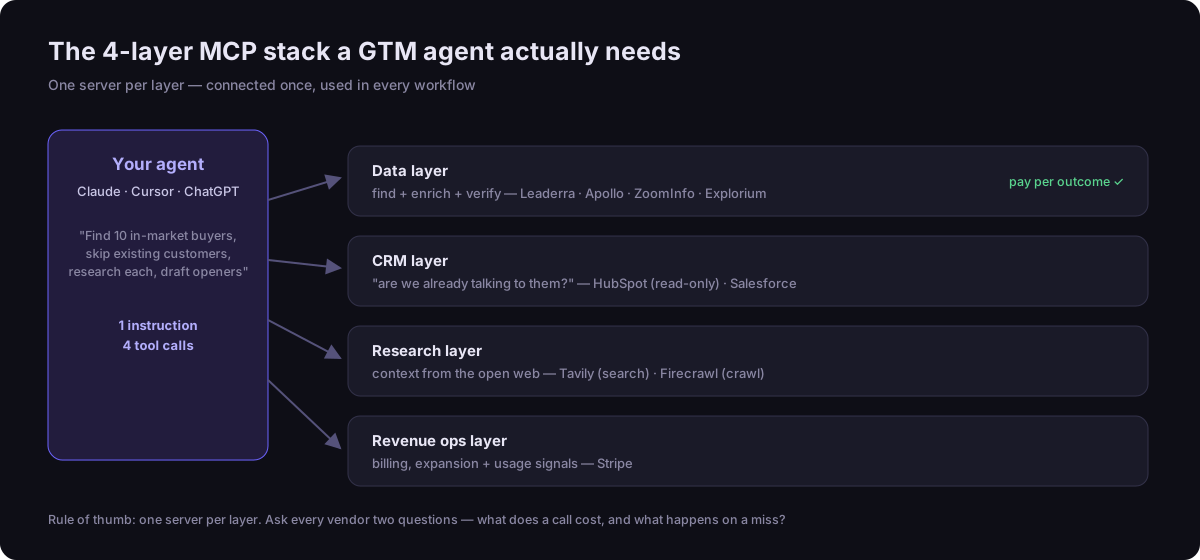
Connect one from each row and your agent can run a real workflow: find a buyer, check they're not already a customer, research their situation, and draft the outreach with full context.
The 4-layer MCP stack a GTM agent needs: data, CRM, research and revenue-ops servers behind one agent instruction
The data layer — where the differences are biggest
Leaderra (ours — judge accordingly). Three tools: find_leads returns scored, briefed leads matched to an offer + ICP, and searching is free; reveal_contact returns a verified email + mobile and is fully refunded on a miss; audit_ads scores a Meta ad account. No seats — the MCP server shares one credit wallet with the app and REST API. We built it agent-first: discovery is open (no key needed to list tools), calls are key-gated. It's on the official registry as io.github.leaderracom-hue/leaderra.
Apollo.Launched its MCP server in February 2026 on all paid plans: search people and companies, enrich records, create contacts, add prospects to sequences. The strongest pick if you already pay for Apollo seats — the MCP access rides your existing plan. The tradeoff is the database model: records age between refreshes, and you pay for the seat whether the data hits or not.
ZoomInfo. Wires its contact, firmographic and intent data into any agent via MCP or API — real enterprise depth, enterprise contract to match. Right when procurement already signed with them; rarely the starting point for a small team.
Explorium. Bulk-analytics angle — segment-level data and events rather than record-at-a-time prospecting. We use it ourselves for market mapping. Complements rather than replaces a reveal-capable data layer.
The CRM layer
HubSpot. The MCP server gives agents read-only access to CRM objects — contacts, companies, deals, tickets and their associations. Read-only is a real limitation (no record creation through MCP yet), but for the most common agent question — "are we already talking to this company?" — it's exactly enough, and it's the safest possible default for a system of record.
Salesforce. Partner and community implementations vary in quality; check what your edition supports before promising your team an agent workflow.
The research layer
Tavily (search) and Firecrawl (crawl/scrape) are the standard web-research building blocks in agent stacks, both with official MCP servers. Neither has contact data — they're the context half. We run both behind our own research features, and they're the reason an agent can say something specific about a prospect instead of something generic.
One honest warning about this category
MCP servers differ in a way listicles hide: what the tool call costs and what happens on failure. A seat-licensed server means your agent's calls are "free" but your team pays whether or not agents use it. A credit-based server means you pay per outcome — which is why we price reveals refund-on-miss: an agent that retries shouldn't burn your budget on failures. Before connecting any server, ask the vendor two questions: what does one call cost, and what happens when it returns nothing? The answers tell you who designed for agents and who ported an API.
For the enrichment-specific shortlist with deeper comparisons, we keep an honest one at best MCP enrichment tools — including where the others beat us.
FAQ
What is an MCP server, in one sentence?
An MCP (Model Context Protocol) server is a small service that describes a tool's capabilities to AI clients like Claude, Cursor or ChatGPT, so the AI can call the tool directly — turning "copy data between tabs" into a single instruction to your agent.
Which MCP server should a small GTM team connect first?
One reveal-capable data server (Leaderra or Apollo, depending on whether you prefer pay-per-verified-reveal or an existing seat plan) plus one research server (Tavily or Firecrawl). That covers finding, enriching and researching — the 80% of agent-driven prospecting. Add CRM read access once agents are producing work worth cross-checking.
Do MCP servers cost extra?
Usually no — calls draw from the same plan or credits as normal product use. Apollo includes MCP on paid plans; Leaderra shares one credit wallet across app, API and MCP. Watch for per-seat products where MCP access requires higher tiers.
Can Clay be used through MCP?
Clay's connector gives agents access to enrichment data already in your Clay workspace, but you can't trigger Clay's waterfalls or Claygent from inside Claude — Clay remains a human-operated canvas. If you want an agent to run the whole find-enrich-verify chain in one call, that's what data-layer servers like ours are for.
How do I connect an MCP server to Claude?
For a remote server like Leaderra: add the server URL and an Authorization header to Claude's MCP settings (Desktop) or a .mcp.json file (Claude Code / Cursor) — no installation. Our Claude integration guide has the exact config.
Put this into practice
Leaderra's four AI agents qualify, chase, and book meetings on your leads — verified, scored, and briefed.